Expert Plumbing Fairfield provides professional tankless water heater installation for homes and businesses in Fairfield, CA. Tankless units cut standby energy waste and free up floor space, but they are not the best fit for every home. We will tell you honestly when a high efficiency tank model makes more sense. Fairfield water runs mineral rich, and that matters more for tankless systems than most people realize. Scale builds up fast on a tankless heat exchanger, so proper installation here means isolation valves for easy descaling, correct sizing, and a straight talk about water treatment.
A traditional tank heater keeps 40 or 50 gallons of water hot, burning fuel whether you need hot water or not. A tankless water heater works differently. Cold water enters the unit, passes through a heat exchanger, and comes out hot only when you open a hot water tap. Nothing is stored, and nothing idles.
A flow sensor fires a gas burner or electric elements, adjusting output to hold a steady temperature, and shuts off when you close the tap. That on demand design is why tankless systems are more efficient: no standby heat loss from a big tank sitting in your garage overnight.
Because nothing is stored, a correctly sized unit never runs out of hot water. But “endless” has a limit: draw more gallons per minute than the unit can heat and the temperature drops. That is why proper sizing is the single most important part of tankless water heater installation.
The efficiency case is simple: no stored water means no standby heat loss. Homeowners also choose tankless for a longer equipment life (no tank to rust out), a compact wall mounted design that frees up floor space, and endless hot water when the unit is sized correctly.
The honest tradeoffs: tankless costs more up front, and in Fairfield’s hard water it needs regular descaling to hold its efficiency. If your household uses little hot water, the payback stretches out. We will walk through the math at your free estimate.
Plan on a professional descale at least once a year in Fairfield; homes with very hard water or heavy use may need it twice a year.
Reduced hot water flow, fluctuating temperatures, longer waits, or display error codes are classic scale symptoms.
A softener or scale prevention device dramatically slows buildup. Not required, but for many Fairfield homes it pays for itself through fewer descales and a longer lasting unit. We will tell you plainly whether your water justifies one.
Cleaning the inlet filter and checking the vent termination takes minutes and prevents bigger problems.
Higher flow rate units for larger households cost more than compact ones.
Gas units generally cost more to install because of venting and gas line work. Electric units are simpler to vent but may need a panel upgrade.
A short, simple vent run costs less than a long route through walls and attic space.
If the existing line cannot feed a tankless burner, upsizing the pipe adds to the project.
Gas units need a simple outlet nearby; whole home electric units can need new dedicated circuits.
Moving the unit to a new spot adds piping and venting work versus a same location swap.
The permit fee, seismic strapping, drain pan, and code required updates are part of an honest quote.
A softener or scale prevention device protects the unit but adds to the initial investment.
Gas tankless water heaters deliver far more heating power, so gas is the better fit for larger households where two or three showers might run at once. The tradeoff is complexity: gas units need proper venting, a gas line that can deliver enough fuel, and combustion air.
Electric tankless water heaters need no venting and no gas line, just dedicated electrical circuits. For a single bathroom or a small accessory unit, electric is an excellent option. For a whole home, electric units often need several large breaker circuits and possibly a panel upgrade, because heating water on demand takes a lot of power.
At every estimate we check your fuel type, panel capacity, simultaneous demand, and venting path, and we will tell you plainly when switching fuel types is or is not worth it.
Sizing is about flow rate, in gallons per minute, and temperature rise: how much the incoming water must be heated. Winter water is cooler than summer, so we size for the coldest month.
We add up your peak demand: what runs at once on a busy morning. A shower uses roughly 2 to 2.5 gallons per minute, a dishwasher about 1.5, a washing machine 2 to 3. Then we match that total to a unit that covers it with headroom.
Undersized units cause the classic complaint: hot water that goes lukewarm when a second fixture opens. The most common sizing mistake we see is trusting the unit’s maximum flow rating, which is measured at a small temperature rise. In real winter conditions the same unit delivers less. We size for your real conditions, not the brochure number.
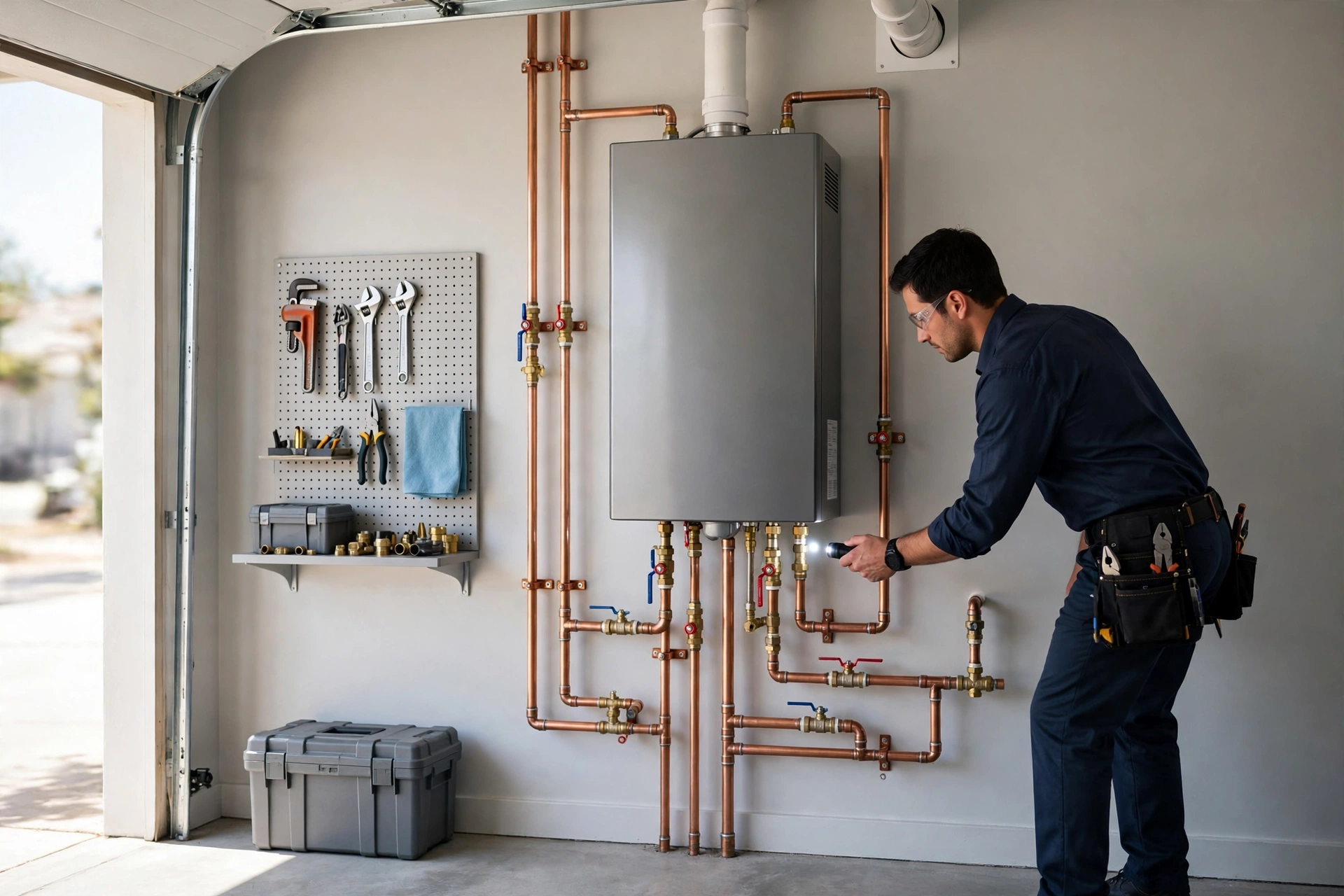
Most of our tankless water heater installation work in Fairfield is a conversion: replacing an old tank with a tankless system. We drain, disconnect, and haul away the old heater, then reroute the water lines to the new wall mounted location.
Three parts of a conversion deserve special attention. Venting (gas units): old tanks use a simple metal flue, but modern high efficiency tankless units need sealed direct venting, often PVC or concentric pipe, terminating outside with proper clearances. Reusing the old vent is unsafe and against code. Gas line (gas units): tankless burners draw far more gas at peak than an old tank, and an undersized line causes performance problems and error codes. We test the supply and upsize the pipe when needed. Service valves: we install isolation valves and service ports with every conversion, which makes future descaling fast and affordable.
Even gas units need an outlet for the controls and fan, and electric whole home units may need new circuits. Replacements in Fairfield require a permit and inspection, including seismic strapping and drain pan setup where required. We pull the permit and handle the inspection.
Step 1: Free estimate and honest assessment. We look at your current setup, hot water habits, gas or electrical service, and water quality, then tell you whether tankless makes sense, which fuel type fits, and what size you need.
Step 2: Straightforward written quote. A clear estimate covering the unit, venting, gas line or electrical work, valves, permit fees, and labor. No surprise line items later.
Step 3: Installation day. Most residential conversions take one full day. We protect your floors, remove the old unit, run new water, gas, and vent lines as needed, then mount and connect the tankless unit.
Step 4: Startup, testing, and walkthrough. We purge the air, verify temperature and flow at multiple fixtures, check for leaks and proper venting, then walk you through the controls, the maintenance schedule, and the display codes. We coordinate the city inspection and leave the work area clean.
Most homes have hot water back by the end of installation day. If your project needs a panel upgrade or major gas line work, we will tell you the realistic timeline up front.
Expert Plumbing Fairfield provides tankless water heater installation throughout Fairfield, CA, including zip codes 94533, 94534, and 94535 covering Travis Air Force Base, plus nearby Vacaville, Vallejo, Benicia, and Dixon. Whether you are in a newer development or an older neighborhood, we size and install systems for the way your household actually uses hot water.
Expert Plumbing Fairfield provides professional tankless water heater installation for homes and businesses in Fairfield, CA. Tankless units cut standby energy waste and free up floor space, but they are not the best fit for every home. We will tell you honestly when a high efficiency tank model makes more sense. Fairfield water runs mineral rich, and that matters more for tankless systems than most people realize. Scale builds up fast on a tankless heat exchanger, so proper installation here means isolation valves for easy descaling, correct sizing, and a straight talk about water treatment.
For many households, yes: energy savings, endless hot water, and longer equipment life. The honest caveat is our hard water. You must descale regularly or pair the unit with water treatment to get the full lifespan.
Most residential conversions take one full day. Projects needing a gas line upsize, panel upgrade, or long new vent run can take longer. You get a realistic timeline with your written estimate.
Possibly. Tankless burners draw far more gas at peak than old tank heaters. We test your supply during the estimate and upsize the line when it cannot keep up. Skipping this step is a common cause of underperforming units.
Almost never. Modern high efficiency tankless units use sealed direct venting with different materials and clearance rules than the old metal flue. Reusing the old vent is unsafe and against code.
At least once a year for most homes. Homes with very hard water or heavy usage may need it twice a year. We install isolation valves and service ports with every unit so the flush is quick, and we can put you on a maintenance schedule.
It depends on how many fixtures run at once and how much the incoming water must be heated in winter. We calculate your peak demand and match it to a unit rated for Fairfield’s winter temperature rise, with a margin.
No. Gas tankless units need electricity for the control board, ignition, and exhaust fan, so they shut down when the power goes out. If outage resilience matters to you, mention it during your estimate and we can discuss options.
Ready for endless hot water and lower standby energy waste? Call +1 707 574 9715 today for your free estimate. We will size your unit honestly, handle the venting, gas line, permits, and inspection, and set you up with a descaling plan for Fairfield’s hard water.
Business: Expert Plumbing Fairfield Hours: Mo,Tu,We,Th,Fr,Sa,Su 09:00-17:00