Every tap, shower, and appliance in your home draws from the same incoming water supply, so a whole-house filtration system treats water at the point where it enters the home rather than at a single faucet. The result is filtered water throughout the house: in the kitchen, in the bathrooms, in the laundry, and in the lines that feed your water heater and fixtures. For Fairfield homeowners who notice taste, odor, or sediment in their water, or who simply want a consistent standard of water quality in every room, whole-house filtration is the broadest way to address it.
Municipal water in Fairfield is treated before it reaches your home, and it meets the standards that apply to public supplies. Even so, water can pick up sediment from aging pipes, carry a chlorine taste or odor from disinfection, or show discoloration after work on nearby mains. Some homes also notice fine particles that settle in a glass, or a taste that changes with the season. Whole-house filtration is designed to reduce these everyday concerns at every tap, rather than asking you to filter each faucet one at a time.
The most common targets are sediment, chlorine taste and odor, and certain chemicals that carbon filtration can reduce. Sediment filters catch sand, silt, rust particles, and other fine debris before they reach your fixtures and appliances. Carbon filters adsorb chlorine and many of the compounds that affect taste and odor. Together, they give the water a cleaner taste and a clearer appearance, and they reduce the particle load that can wear on fixture aerators, showerheads, and appliance inlet screens.
Filtration and softening are often confused, and the confusion leads to mismatched systems. Filtration removes sediment, taste, odor, and certain chemicals. Softening removes hardness minerals, mainly calcium and magnesium, that cause scale buildup and spots. A filtration system will not soften your water, and a softener will not filter sediment or improve chlorine taste on its own. Many homes benefit from one or the other, and some benefit from both, installed as separate stages with separate jobs.
If your main complaints are white scale on fixtures, spots on dishes, or stiff laundry, the concern is hardness, and water softener installation is the conversation to have. If your main complaints are taste, odor, sediment, or discoloration, filtration is the starting point. If you have both sets of complaints, a combined setup can be planned so that filtration protects the softener from sediment and the softener handles the hardness, with each stage doing the job it was built for. Naming the concern first keeps the equipment honest and the expectations realistic.
ap is served
ter changes
enance
ot a generic bundle
e service
Most whole-house systems combine two or more stages, and each stage has a distinct role. A sediment pre-filter is usually first, catching particles so they do not clog the finer stages behind it. A carbon stage follows, reducing chlorine taste and odor and adsorbing a range of organic compounds. Some systems add a finer polishing stage or a specialty media stage aimed at a specific concern identified in the water.
Stage order matters, because a carbon stage lasts longer and performs better when sediment is removed first. Filter life depends on the water quality, the household usage, and the capacity of each cartridge, so replacement intervals are estimates to be checked against what you actually observe, such as a drop in flow or a return of taste. Keeping a simple log of change dates helps you spot when a stage is wearing out sooner than expected, which can itself be a clue about a change in the incoming water.
Whole-house filtration is one part of a broader set of water treatment choices, and it helps to see where it sits. Broader water treatment planning can include softening for hardness, specialty treatment for a specific water concern, and point-of-use options for drinking water at a single tap. Each option answers a different question, and the right combination depends on what your water tests show and what you actually notice day to day.
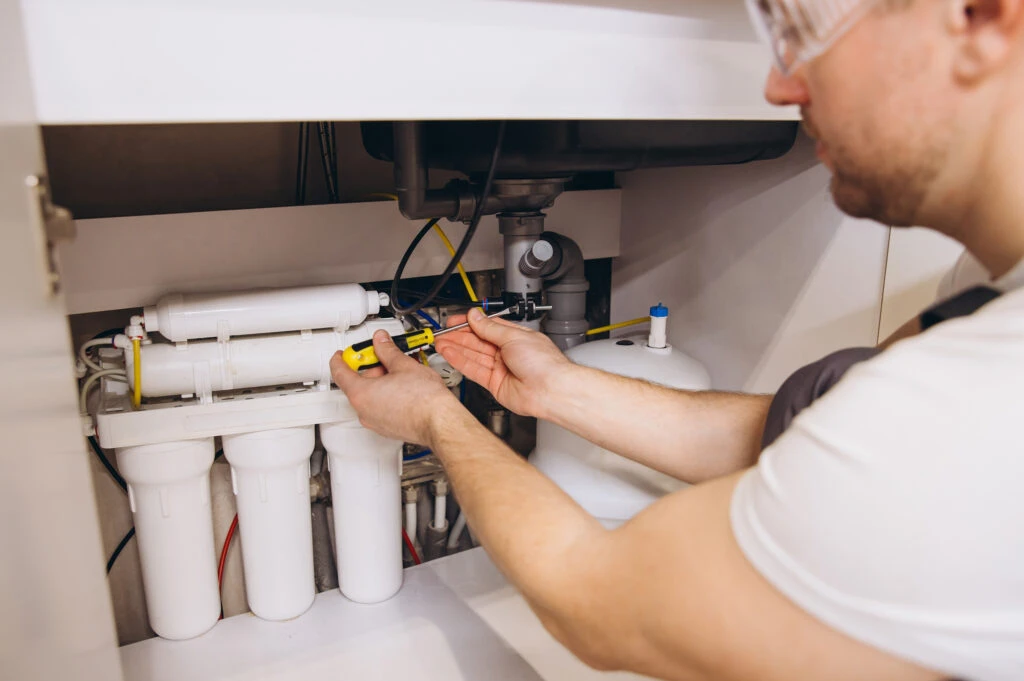
Two point-of-use options deserve a clear explanation, because they are often sold as if they were whole-house solutions. Reverse osmosis is a fine filtration process typically installed under a kitchen sink to polish drinking water at that one tap, producing a small stream of highly filtered water for drinking and cooking. Ultraviolet treatment is a disinfection step that exposes water to UV light to address microbiological concerns, usually as part of a targeted setup rather than as a general taste or sediment fix. Neither replaces a whole-house sediment and carbon system, and neither is needed in every home. They are sections of a larger water treatment conversation, useful when the specific concern calls for them.
A whole-house filter sits in the path of all your water, so its flow capacity matters. A system that is too small for the household can reduce pressure when several fixtures run at once, turning a morning shower into a weak trickle while the washing machine fills. Sizing takes the home’s plumbing, the number of bathrooms, and the household’s peak usage into account, and it should leave enough capacity that the system still performs well as filters age between changes.
Pressure drop across the filters is normal and grows as cartridges load with sediment. If pressure falls off sharply soon after a filter change, something else may be going on, such as a partially closed valve, and it is worth having checked rather than living with it.
Whole-house filtration is low maintenance, but it is not maintenance free. Sediment cartridges are changed most often, carbon stages less often, and the housings themselves need periodic inspection for wear, sediment buildup, and seal condition. The exact intervals depend on your water and your usage, and your installer should give you a starting schedule plus the signs that a change is due sooner, such as reduced flow or returning taste.
Filter changes are straightforward when the system was installed with access in mind: close the shutoffs, relieve pressure, swap the cartridges, and restore flow. Keeping a spare set of cartridges on hand avoids a gap in filtration while replacements are ordered.
Honest expectations make for satisfied homeowners. Whole-house filtration will not soften hard water, will not remove every dissolved substance, and will not correct a plumbing problem such as corroded piping or a failing fixture. If your water concern turns out to be hardness, a softener is the answer. If it turns out to be a specific contaminant, that concern needs its own test and its own targeted solution, not a generic filter sold as a cure for everything.
Testing avoids guesswork. A basic water test can confirm hardness, chlorine levels, and sediment load, giving the installer a factual basis for recommending stages. If a concern shows up that filtration cannot address, a straightforward installer will say so and point you toward the option that can.
Fairfield homes differ in age, pipe material, and water use, and those differences shape the recommendation. An older home with galvanized or aging piping may benefit most from a strong sediment stage, while a newer home may need little more than carbon for taste and odor. A larger household with several bathrooms needs more flow capacity than a small household, and a home with a water softener already in place needs filtration planned around it, not in competition with it.
Budget should cover both the installation and the ongoing cartridge cost. A system with inexpensive cartridges that need frequent changing can cost more over time than a larger system changed less often, so ask for the expected cartridge schedule in plain terms.
Every tap, shower, and appliance in your home draws from the same incoming water supply, so a whole-house filtration system treats water at the point where it enters the home rather than at a single faucet. The result is filtered water throughout the house: in the kitchen, in the bathrooms, in the laundry, and in the lines that feed your water heater and fixtures. For Fairfield homeowners who notice taste, odor, or sediment in their water, or who simply want a consistent standard of water quality in every room, whole-house filtration is the broadest way to address it.
It treats water at the point where it enters the home, so every tap, shower, and appliance receives filtered water. It typically targets sediment, chlorine taste and odor, and certain chemicals that carbon filtration can reduce.
No. Filtration removes sediment, taste, odor, and certain chemicals, while softening removes hardness minerals such as calcium and magnesium. Homes with both concerns may need a filtration stage and a softener, each doing its own job.
On the main water line where it enters the home, usually near the shutoff in a garage, utility area, or accessible crawl space point, with shutoffs and a bypass so water can flow during filter changes.
It depends on water quality, household usage, and cartridge capacity. Sediment cartridges are usually changed most often and carbon stages less often, with reduced flow or returning taste as signs a change is due sooner.
No. Reverse osmosis is typically a point-of-use system under a kitchen sink that polishes drinking water at one tap. It complements, rather than replaces, a whole-house sediment and carbon system.
Filtration can reduce sediment and particles that cause many discoloration complaints. If discoloration comes from a plumbing problem or a specific water concern, testing helps identify the cause and the option that can actually address it.
If taste, odor, or sediment in your water is a daily annoyance, or you want filtered water at every tap in your Fairfield home, start with a conversation about what your water actually shows and which stages address it. Call +1 707 574 9715, open daily 9:00 AM to 5:00 PM, to discuss whole-house water filtration for your home.
Business: Expert Plumbing Fairfield Hours: Mo,Tu,We,Th,Fr,Sa,Su 09:00-17:00