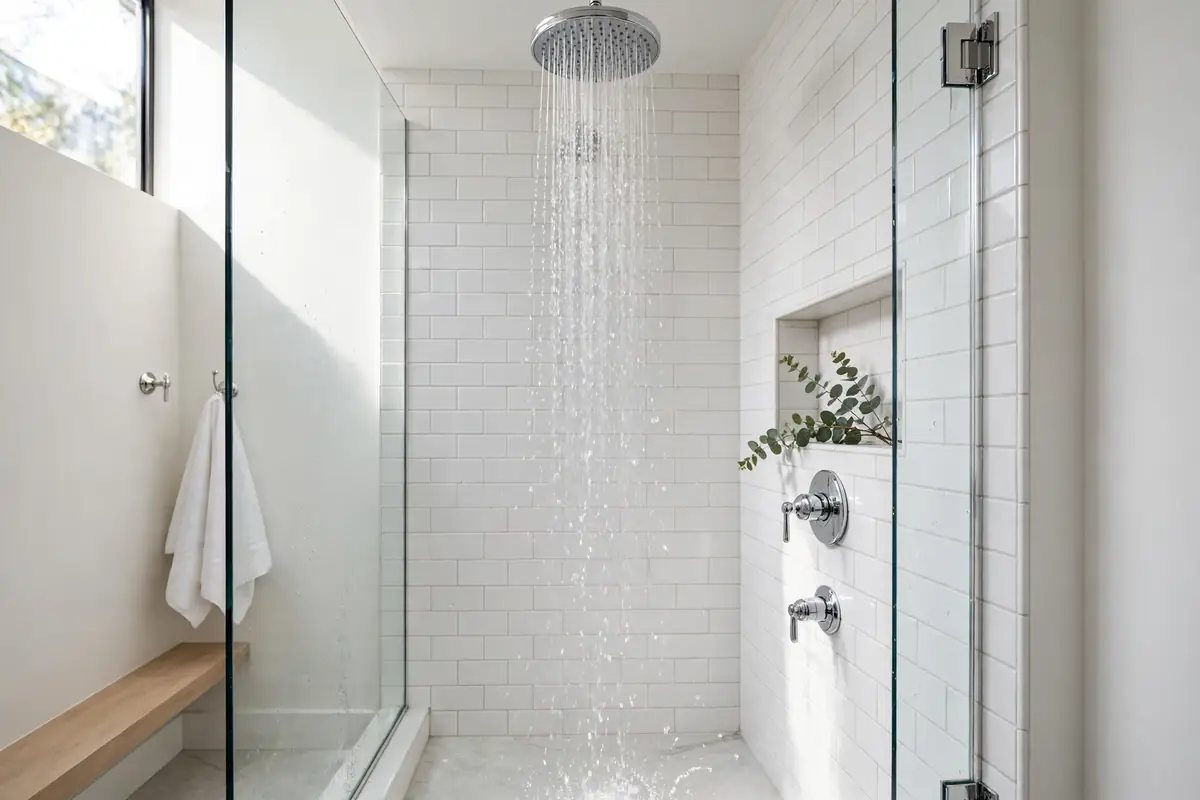
Shower Pressure Low Only in the Shower? Head, Restrictor, and Valve Causes in Fairfield
Your shower has gone from a strong spray to a weak trickle, but the rest of the house seems fine. That detail matters more than anything else here. When only one shower is weak, the cause is almost always in that shower itself: the showerhead, the flow restrictor, the cartridge in the mixing valve, or the shutoff valve feeding that branch. This post stays strictly on that branch and does not re-answer the whole-house low-pressure question. If other fixtures are weak too, that is a different problem, and this post will point you to the right guide for it.
If your shower pressure is low and you would like a plumber to look at it, call +1 707 574 9715.
The One-Shower Test: Check the Other Fixtures First
Before you touch the shower, run the test that decides which guide you need. Turn on the cold tap at the bathroom sink, then the hot tap, then the kitchen tap. Flush a toilet and watch the sink while it refills. If every other fixture runs at normal strength and only the shower is weak, the problem is in the shower branch, and the fix ladder below is for you.
If the kitchen tap is weak too, or the bathroom sink is a trickle, or the whole house feels low, stop here and read our guide to low water pressure in Fairfield instead. That guide covers the upstream causes: the main shutoff, the pressure-reducing valve, and a hidden leak. Fixing a showerhead will not help a house-wide problem. Note the result before you move on: it is the first thing a plumber will ask about.
The Showerhead: Scale-Clogged Nozzles
The most common cause of a weak single shower is the showerhead itself, and in Fairfield the usual culprit is scale. Fairfield tap water is hard, so it leaves mineral deposits behind as it flows. Those deposits build up inside the small nozzles, narrowing each opening a little at a time. The spray gets weaker over months, not overnight, which is why many people do not notice it until the shower is barely a trickle.
Look closely at the face of the showerhead. If some nozzles spray straight and others dribble or spray sideways, or if the face has a pale, crusty coating, scale is the likely cause. The standard fix is to remove the showerhead and soak it in plain white vinegar for a few hours. The vinegar loosens the mineral deposits. After the soak, rinse the head, poke any nozzles that are still blocked with a toothpick or a pin, and run water through it before refitting it. If the spray comes back, scale was the problem.
If the showerhead is old and the soak does not help, replacing the head is a reasonable next step. It also lets you check something important: with the head off, turn the shower on briefly. If the flow from the bare arm is strong, the head was the restriction. If it is still weak, the problem is further back. Our guide to hard water signs in Fairfield covers the other places scale shows up in a home.
The Flow Restrictor: A Small Part With a Big Effect
Inside most modern showerheads, or in the fitting where the head connects to the arm, sits a small flow restrictor: a disc or insert with a tiny opening that limits how much water the shower uses. Over time, scale and fine grit can lodge in that opening and narrow it further, until the shower is barely delivering any.
When you have the showerhead off for the vinegar soak, look inside the fitting for the restrictor: usually a small plastic or metal disc with a hole in the middle, sometimes with a tiny filter screen. Rinse it, clear any grit from the opening, and check the screen for debris. If it is clogged with scale, a vinegar soak works here too. Refit it and test the shower. If the flow comes back, the restrictor was the restriction. Do not leave it out permanently: it is part of the fitting, and removing it changes how much water the shower uses.
The Cartridge: The Mixing Valve Inside the Wall
If the head and the restrictor are both clear and the shower is still weak, the next suspect is the cartridge inside the shower mixing valve: the part behind the handle that mixes hot and cold water and controls the flow. Its small passages can clog with scale and grit, or its seals can wear and swell until they restrict the flow. A cartridge problem often shows up in one of two ways: the shower is weak on both hot and cold, or the temperature swings hot and cold while the flow stays low.
Testing the cartridge is a plumber’s job in most cases, because it means turning off the water to the shower, removing the handle and trim, and pulling the cartridge out of the valve body. The cartridge is a replaceable part, and a new one often restores full flow, but the valve body is inside the wall and the work needs the right cartridge for the valve model. If you have cleared the head and the restrictor and the flow is still weak, the cartridge is the most likely next cause. Our shower repair service covers cartridge replacement and valve work.
The Branch Shutoff: A Valve That Is Only Half Open
Every shower is fed through shutoff valves, and one of them may be only partly open. Some homes have shutoff valves for the shower branch in a nearby access panel, a closet, or behind the shower wall. Others have the shower fed from valves under the bathroom sink or in a utility space. A valve that was turned down during earlier work and never turned back up, or a valve whose handle is stiff and has drifted, will starve the shower of water while every other fixture runs normally.
If you can find the shutoff valves feeding the shower, check that they are fully open. Turn them gently to the fully open position and test the shower again. Do not force a stiff valve: an old valve can break or start leaking if forced, and a leaking valve is worse than a weak shower. If the valve is stiff, corroded, or already fully open and the shower is still weak, leave it alone. This check is free and takes a minute, but it is not worth breaking a valve over.
When the Shower Loses Pressure While Another Fixture Runs
The shower runs fine on its own, but the moment someone flushes the toilet or runs the kitchen tap, the shower goes weak or the temperature swings. That happens because the shower shares its cold-water line with other fixtures, and when another fixture opens, the shower gets less water for a moment. Most modern shower valves have a pressure-balancing feature that smooths this out. When that feature stops working, usually because the cartridge is worn or clogged, the shower takes the full hit every time another fixture runs. The fix is usually the cartridge, covered above. This symptom points at the shower valve and its branch, not at the whole-house supply.
When It Is Not the Shower After All
There are cases where a weak shower turns out to be an upstream problem after all. If the shower is weak and the bathroom sink is also weak, but the kitchen is fine, the restriction is in the branch feeding that bathroom, not the shower alone. If the shower is weak only on hot water, the cause may be in the hot-water side: scale in the heater or a restriction in the hot line. If the whole house has dropped, the cause is upstream.
For the whole-house branch, read our guide to low water pressure in Fairfield. For the upstream valve that controls pressure for the whole home, see our pressure-reducing valve service. Those are the right guides once the one-shower test says the problem is bigger than the shower.
The Bottom Line
A shower that is weak on its own is a shower-branch problem, and the fix ladder runs in order: check the other fixtures first, then the showerhead, then the flow restrictor, then the branch shutoff, then the cartridge. Scale is the most common cause in Fairfield, and it is the cheapest to rule out. If the head and the restrictor are clear and the flow is still weak, the cartridge or a restriction behind the wall is the likely cause, and that is plumber work.
Need Help in Fairfield?
If your shower is the only weak fixture and the head and restrictor are clear, we can check the valve and the branch feeding it. We are open 09:00-17:00 daily. Call +1 707 574 9715 to book a visit.