
How to Fix a Dripping Faucet in Fairfield: Washer, O-Ring, and Cartridge Causes
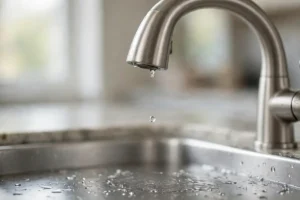
A dripping faucet is a small sound with a steady cost. One drip every few seconds does not look like much, but it runs day and night, and it is a sign that a part inside the faucet has worn out. Most drips come from one of a small set of causes, and the cause depends on the type of faucet you have. Before you buy parts or take anything apart, there are two steps that come first: shut off the water at the sink shutoffs, and work out which type of faucet you are dealing with.
If a faucet in your home keeps dripping and you would like a plumber to fix it, call +1 707 574 9715. We are open 09:00-17:00 daily.
First: Shut Off the Sink Shutoffs
Every sink should have shutoff valves underneath it, usually one for hot and one for cold, where the supply lines meet the wall or the floor. Turn both of them clockwise until they stop, then open the faucet and let any water left in the lines drain out. This is the step that keeps a small repair from becoming a wet floor. If the shutoffs turn freely without stopping the flow, or if they drip when you turn them, stop there and call a plumber. Put the plug in the sink or lay a cloth over the drain before you remove any small part, because washers and screws are exactly the size that disappears down a drain.
While the water is off, do not torque down on the dripping faucet to try to stop it. Forcing a handle tighter is the most common way a small drip becomes a bigger repair. On a washer faucet, overtightening crushes the washer and can damage the seat it presses against. On a cartridge faucet, it can crack the cartridge or wear the seals. If the drip stops when you lean on the handle, it is not fixed. It is being held shut by force, and the worn part underneath is still worn.
Identify the Faucet Type Before Buying Parts
Faucets fall into four common types, and the parts inside them are different, so the first job is to work out which one you have. A compression faucet has separate hot and cold handles, and each handle turns several times to open and close. A ball faucet has a single handle that moves in an arc over a rounded cap. A cartridge faucet also has a single handle, but it moves up and down and side to side in a straighter motion. A ceramic disc faucet has a single lever that moves with a short, smooth quarter turn.
If you are not sure which type you have, look at how the handle moves and how far it turns, and take a photo of the faucet and its handle before you take anything apart. That photo helps you put the faucet back together in the right order, and it helps a plumber or a parts counter identify the model if you need a part. Do not buy parts before you know the type.
Compression Faucets: The Seat Washer
A compression faucet closes by pressing a rubber washer down onto a metal seat. Each time the tap is used, the washer is squeezed, and over time the rubber hardens, cracks, or wears thin. When it can no longer press flat against the seat, water seeps past it, and the tap drips from the spout even when the handle is fully closed. With the water off, the handle and the packing nut come off, the stem lifts out, and the washer at the bottom of the stem can be seen and replaced. The replacement needs to be the same size and shape as the old one, so take the old washer with you when you buy it.
Check the seat while the stem is out. The seat is the metal ring the washer presses against, and if it is rough, pitted, or grooved, a new washer alone will not seal. A rough seat will wear a new washer out quickly, and the drip will return. A seat can be smoothed with a seat wrench, a tool made for the job, but if the seat is deeply pitted, that is the point to call a plumber. A drip from the handle itself, rather than from the spout, usually points to the packing around the stem rather than the washer.
Cartridge and Ball Faucets: O-Rings and Cartridges
Cartridge faucets do not have a washer pressing onto a seat. They have a cartridge, a single unit inside the faucet body that controls the flow and the mix of hot and cold water. When a cartridge faucet drips from the spout, the cartridge itself is usually worn, and the O-rings that seal around it may be worn as well. A drip from around the base of the handle usually points to the O-rings. Replacing O-rings is a homeowner-level job: with the water off and the handle removed, the old rings can be lifted off and new ones of the same size fitted in their place. Take the old O-rings with you when buying replacements.
Cartridge replacement is the point where this guide hands the job to a professional. A cartridge is specific to the brand and model of the faucet, and fitting the wrong one can leave the faucet dripping, or stuck, or mixing hot and cold water wrongly. Removing a cartridge that has been in place for years can also be difficult, because mineral build-up can hold it fast, and forcing it can damage the faucet body. That is why the boundary is drawn here: O-rings are a homeowner job, cartridge replacement belongs to a plumber. Ball faucets sit on the same side of the line: they use a ball with slots, springs, and rubber seats inside, and the assembly is fiddly and easy to get wrong.
Ceramic Disc Faucets: When the Drip Means Replacement Parts
Ceramic disc faucets are the newest of the four types, and they are built differently. Two ceramic discs sit face to face inside the faucet, and turning the handle slides them so their openings line up or close off. The discs themselves are hard and long-lasting, and they rarely wear out. When a ceramic disc faucet drips, the cause is usually the seals around the discs. The discs are not a part a homeowner should try to service: they are fragile, and a small scratch can leave the faucet dripping worse than before. For this type, the sensible homeowner step is diagnosis, not repair: note whether the drip comes from the spout or the base, and whether it is hot, cold, or both, then call a plumber.
Where the Drip Comes From Tells You the Part
The leak location is a diagnostic clue in itself. A drip from the spout when the faucet is off points to the part that seals the waterway: the washer on a compression faucet, the cartridge on a cartridge faucet, or the seals on a ceramic disc faucet. A drip from around the base of the handle points to the O-rings or the packing around the stem. Water pooling at the base of the faucet, where it meets the sink, usually points to the seals under the faucet body, and that is plumber work. Anything behind the wall is also past the homeowner line: if the drip is coming from inside the wall, if the shutoff valves under the sink do not work, or if the faucet is loose in a way that suggests the mounting underneath has failed, stop and call a plumber.
The Short Version
Shut off the sink shutoffs first, identify the faucet type before buying parts, and never torque down on a dripping faucet to force it shut. On a compression faucet, the washer and the seat are the usual cause, and a washer swap is a fair homeowner job. On a cartridge faucet, O-rings are a homeowner job and cartridge replacement is not. On a ball faucet, the small spring and seat parts are best left to a plumber. On a ceramic disc faucet, the discs themselves should not be handled at home.
If your faucet keeps dripping after a washer or O-ring change, or if you are not sure which type of faucet you have, call +1 707 574 9715. We are open 09:00-17:00 daily, and we can identify the faucet, fit the right part, and stop the drip properly. Our faucet repair page covers professional repair, and our fixture installation page covers replacement when repair is no longer the sensible choice. If the pressure seems low too, see our guide to low water pressure in Fairfield.