
Do Fairfield Homes Have Lead Pipes? How to Check Your Water Service Line
Lead in drinking water is one of those worries that is hard to settle by looking at a tap, because the pipe that matters most is buried outside the house. The service line is the pipe that runs from the street main to your home, and its material decides whether lead can enter your water before it ever reaches your kitchen. The honest answer for Fairfield starts with the verified facts, and those facts are reassuring. Fairfield Municipal Utilities completed its service line inventory on December 5, 2024, and the State Water Resources Control Board reported in January 2026 that no service lines have been identified as lead in California out of about 10 million lines reported. About 600,000 lines statewide are still of unknown material, so the question stays open for individual homes.
This guide explains what a service line is, how to check the material of the line that serves your home, what Fairfield Municipal Utilities found in its inventory, and how to get your own line verified. It does not diagnose lead safety, and it does not tell you whether your water is safe to drink. Testing questions belong with the utility, and this guide points you to the utility at every step where a test or a verdict is needed. If a plumbing problem in your home needs a look, we can help. We are open 9am to 5pm daily. Call +1 707 574 9715 to book a visit.
What a Service Line Is
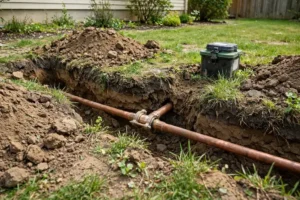
Your home has two sets of pipes, and the service line is the one you cannot see. It runs underground from the water main in the street to the point where it enters your house, usually near the water meter. Everything inside the house, the pipes under your sinks and behind your walls, is a separate question. The service line material is what the inventory was about, and it is the only pipe this guide covers. Our post on polybutylene and galvanized pipes in Fairfield covers the materials used inside homes, which is a different question with different answers.
Lead service lines were installed in many American cities in the early twentieth century, which is why the federal Lead and Copper Rule required every water system to inventory its lines. Fairfield was late to that inventory. The city itself reports that it failed to complete the initial inventory by the federal deadline, and then completed it on December 5, 2024. That is the public record, and it is the starting point for any homeowner who wants to know where their home stands.
How to Check Your Own Service Line
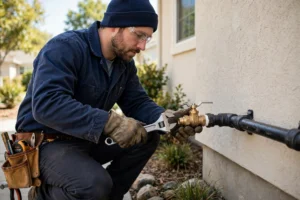
The simplest check you can do yourself is the scratch and magnet test, and it needs only a coin and a fridge magnet. Find where the service line enters your house, usually at the meter or where the pipe comes through the wall. Scratch the surface of the pipe gently with the coin. Lead is soft and dull grey, and a fresh scratch turns bright and silvery. Then hold the magnet to the pipe. A magnet does not stick to lead. If the pipe is grey, soft enough to scratch easily, and the magnet does not stick, it could be lead, and that is the point to stop guessing and contact the utility.
Two other materials show up in this test, and knowing them saves a false alarm. Copper is reddish brown and the magnet does not stick to it either, but copper is not soft and grey. Galvanized steel is grey too, but a magnet sticks to it firmly. If the magnet sticks, the line is steel, not lead. The scratch test only works on the exposed part of the line where it enters the house, and it tells you the material of that one stretch of pipe. It does not tell you what is buried between the street and the house, which is why the inventory and the city survey matter.
Fairfield runs a water service line survey that asks residents for the exterior service line material and the installation year of their home. That survey is the route to getting your home counted in the city’s records. The contact for lead and copper questions is leadandcopper@fairfield.ca.gov, and the phone number is 707 428 7485. If the scratch test leaves you unsure, or if you want your line checked against the city’s inventory, those are the people to ask. Do not rely on a neighbour’s line as evidence about your own, because two homes on the same block can have different materials.
What the Inventory Found
The inventory is the public record of what Fairfield Municipal Utilities knows about the lines it serves. The State Water Board summary from January 2026 says that no service lines have been identified as lead in California out of about 10 million lines reported, and that about 600,000 lines statewide are still of unknown material. That statewide figure includes homes across California, not only Fairfield, and it is worth reading plainly. No lead lines identified is a strong result. About 600,000 unknown lines is the gap that keeps the question open for individual homes.
The city’s 2024 Consumer Confidence Report carries the federal lead information section, which says lead in drinking water comes primarily from materials and parts used in service lines and in home plumbing. The report also says tap sampling for lead was compliant in the 2023 round, with the next round scheduled for summer 2026. Those are the city’s own published facts, and this guide does not go beyond them. It does not claim Fairfield has no lead pipes, and it does not claim Fairfield has lead pipes. The inventory is complete, the statewide result is no lead lines identified, and about 600,000 lines statewide remain unknown. A homeowner who wants certainty about one specific home should ask the utility to check that home.
Who Owns Which Side of the Line
Ownership matters because it decides who replaces a line if one ever needs replacing. The California Department of Public Health explains that utilities replace the lines they own, and homeowners own the private side. In practice, the utility owns the main and the portion of the service line up to the meter or the property boundary, and the homeowner owns the portion from there into the house. That split is why the scratch test is done at the entry point, and why a homeowner who finds lead on the private side would need to talk to the utility about the public side separately.
The city survey asking residents for their exterior line material is how the private side gets counted.
Lead and the Rest of Your Water
A service line is only one part of the water picture, and other symptoms point to other causes. Brown or discoloured water usually comes from sediment or rust in the pipes, and our post on brown water from the faucet in Fairfield covers what that means. A metallic taste, a chlorine taste, or an earthy taste each has its own cause, and our post on why your water tastes bad in Fairfield walks through them. A rotten egg smell or a chemical smell is a different question again, and our post on why your water smells in Fairfield covers it. None of those symptoms is a test for lead, and none of them rules lead in or out. Only the line material and a proper test do that, and the test is the utility’s job.
Hard water is a separate Fairfield fact worth keeping apart from the lead question. Fairfield water is hard, and hard water leaves scale on fixtures and shortens the life of heaters, which our Fairfield water hardness guide documents. Hardness is a mineral question, not a lead question, and a softener does not change the material of your service line. If your line ever needs replacing, that is a water line job, and our page on water line replacement covers what that work involves.
The Bottom Line
Fairfield completed its service line inventory on December 5, 2024, and California reports no lead service lines identified out of about 10 million lines, with about 600,000 lines still of unknown material. The scratch and magnet test gives you a first read on your own line, and the city’s survey and the lead and copper contact at leadandcopper@fairfield.ca.gov or 707 428 7485 are the route to a verified answer for your home. Do not guess from a neighbour’s line, and do not treat a taste, a smell, or a colour as a test for lead. If a plumbing problem in your home needs a look, we can help. We are open 9am to 5pm daily. Call +1 707 574 9715 to book a visit.