
How Hard Is Fairfield, CA Tap Water?
Fairfield tap water is hard water. The City of Fairfield’s own water quality reports put the average hardness at 157 parts per million (ppm) in 2024, which converts to about 9.2 grains per gallon (gpg). On the U.S. Geological Survey (USGS) scale, that average falls in the “hard” band. But a single average hides a wide range: in 2024, individual samples ranged from 76 to 239 ppm, so how hard it feels at your tap depends on the source blend reaching it that day.
This guide gives you the verified numbers from the City of Fairfield’s Consumer Confidence Reports, explains what ppm and gpg mean, describes where Fairfield’s water comes from, and covers what hard water does in a home and what you can do about it. Every figure is dated to its report year, and the 2024 report is the latest verified year; no 2025 figure was available, so none is given here.
If hard water is already causing problems in your home — scale on fixtures, a water heater that sounds different, or a softener that is not behaving — we can take a look. We are open 09:00-17:00 daily. Call +1 707 574 9715 to book a visit.
The Short Answer: Fairfield Water Is Hard
Water hardness measures dissolved calcium and magnesium, the minerals water picks up as it moves through soil and rock. The more dissolved mineral, the harder the water. Fairfield’s water comes from surface sources that carry a real mineral load, and the city’s own testing confirms it year after year.
The 2024 report recorded an average total hardness of 157 ppm (about 9.2 gpg, a conversion), with samples from 76 to 239 ppm. The 2024 average sits in the USGS “hard” band, and the top of its range crosses into “very hard” territory. The 2024 report also states that no violations or exceedances were recorded in 2024.
The Verified Numbers, Year by Year
Here are the figures from the City of Fairfield’s Consumer Confidence Reports, Table 3 in each report. The gpg figures are arithmetic conversions (1 gpg = 17.1 mg/L), not figures the city published, and they are labelled as conversions throughout this guide.
- 2024: total hardness ranged from 76 to 239 ppm, with an average of 157 ppm (about 9.2 gpg, a conversion). Source: City of Fairfield 2024 Consumer Confidence Report, Table 3.
- 2023: total hardness ranged from 63 to 238 ppm, with an average of 112 ppm (about 6.5 gpg, a conversion). Source: City of Fairfield 2023 Water Quality Report, Table 3.
- 2022: total hardness ranged from 72 to 229 ppm, with an average of 162 ppm (about 9.5 gpg, a conversion). Source: City of Fairfield 2022 Consumer Confidence Report, Table 3.
- 2019: total hardness ranged from 64 to 220 ppm, with an average of 130 ppm (about 7.6 gpg, a conversion). Source: City of Fairfield 2019 Annual Water Quality Report, Table 3.
Read together, the four verified years tell a consistent story. The typical average runs about 110 to 160 ppm (about 6.5 to 9.5 gpg, conversions), but individual samples have ranged from about 63 to about 239 ppm. No single year’s average should be quoted as “the” hardness without its year, because the average moved from 112 ppm in 2023 to 157 ppm in 2024.
What ppm and gpg Mean
Hardness is reported in one of two units. Parts per million (ppm) is the same as milligrams per litre (mg/L) as calcium carbonate. Grains per gallon (gpg) is the older American unit, still used by most water softener makers and many plumbers. One grain per gallon equals 17.1 mg/L, so you divide a ppm figure by 17.1 to get gpg. The 2024 average of 157 ppm gives about 9.2 gpg; 2023’s 112 ppm converts to about 6.5 gpg; 2022’s 162 ppm to about 9.5 gpg; and 2019’s 130 ppm to about 7.6 gpg. All four gpg figures here are conversions worked out this way, not numbers the city published.
The USGS Hardness Scale
The U.S. Geological Survey’s Water Science School classifies water hardness on a simple scale, in mg/L as calcium carbonate:
- 0 to 60: soft
- 61 to 120: moderately hard
- 121 to 180: hard
- More than 180: very hard
On that scale, the 2024 average of 157 ppm is hard, the 2023 average of 112 ppm is moderately hard, and the 2022 and 2019 averages of 162 and 130 ppm are hard. The top end of every verified year’s range — 239 ppm in 2024, 238 ppm in 2023, 229 ppm in 2022, and 220 ppm in 2019 — is very hard. Fairfield water is never soft on this scale.
Where Fairfield’s Water Comes From
Fairfield’s public water system is City of Fairfield system No. 4810003. Its water comes from surface sources: Lake Berryessa and the Sacramento Delta, delivered through the Putah South Canal and the North Bay Aqueduct. Treatment happens at the Waterman Water Treatment Plant and the North Bay Regional Water Treatment Plant. The two sources do not carry identical mineral loads, so the blend reaching your home shapes the hardness at your tap.
What Hard Water Does in a Home
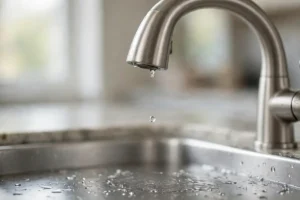
Hard water leaves its mark in predictable places. When heated water evaporates or cools, dissolved calcium and magnesium drop out of solution and form scale, a hard chalky crust on hot surfaces. You will see it as white spots on glassware and fixtures, a crusty ring around a faucet aerator, and a film on shower doors that does not wipe away with a normal cleaner.
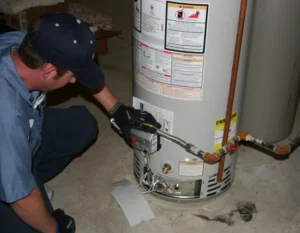
Inside the plumbing, scale narrows passages and insulates heating surfaces. A tankless water heater is the most sensitive appliance in the house, because its heat exchanger is a tight bundle of narrow passages built to heat moving water in seconds; even a thin scale layer makes it work harder and can push it toward overheating. Our guide to tankless water heater descaling in Fairfield explains the signs and the timing. Tank water heaters collect the same minerals as sediment at the bottom of the tank, which is why flushing matters, as our post on how often to flush a water heater in Fairfield covers. Regular water heater maintenance keeps both kinds of unit in better shape in hard water.
Scale also shortens the life of fixtures and appliances that heat water, stiffens laundry, and leaves soap scum — slow, cumulative damage, not overnight. For the visible signs to watch for, see our post on hard water signs in Fairfield homes.
How to Tell How Hard Your Water Is
The city-wide figures describe Fairfield’s water in general. Your own tap may sit anywhere in the range, and the only way to know your number is to test your own water. A home test kit or test strip gives a rough reading — enough to place your water in the moderately hard, hard, or very hard band — and this guide does not recommend any particular brand. For a precise figure, a laboratory test of a sample from your tap is the reliable route. Either way, test more than once: a single reading is a snapshot of a blend that changes.
If your softener seems to be struggling, our post on a water softener not using salt in Fairfield covers the common causes.
What to Do About Hard Water
Hard water is a water-quality fact in Fairfield, not a fault in your plumbing. If the problem is spots and soap scum, a water softener is the standard answer: it exchanges calcium and magnesium for sodium and delivers soft water to the whole house. Our water softener installation service covers sizing and installation for Fairfield homes.
If the concern is taste, odour, or particles rather than hardness, that is a filtration question, not a softening question — a softener does not filter. Our whole-house water filtration service covers that side. If your main worry is protecting a tankless heater, a descaling schedule matched to your water and usage is the practical step, and a softener upstream of the heater slows scale formation.
One caution: do not size a softener on a single year’s average. Because the average moved from 112 ppm in 2023 to 157 ppm in 2024, a unit sized only for the softer year would be undersized in a harder year.
The Bottom Line
Fairfield tap water is hard water. The verified averages are 157 ppm in 2024 (about 9.2 gpg, a conversion), 112 ppm in 2023 (about 6.5 gpg, a conversion), 162 ppm in 2022 (about 9.5 gpg, a conversion), and 130 ppm in 2019 (about 7.6 gpg, a conversion). Across those years, the typical average runs about 110 to 160 ppm, and individual samples have ranged from about 63 to about 239 ppm. If hard water is already costing you fixtures or a noisy heater, we can help you work out the right fix. We are open 09:00-17:00 daily. Call +1 707 574 9715 to book a visit.